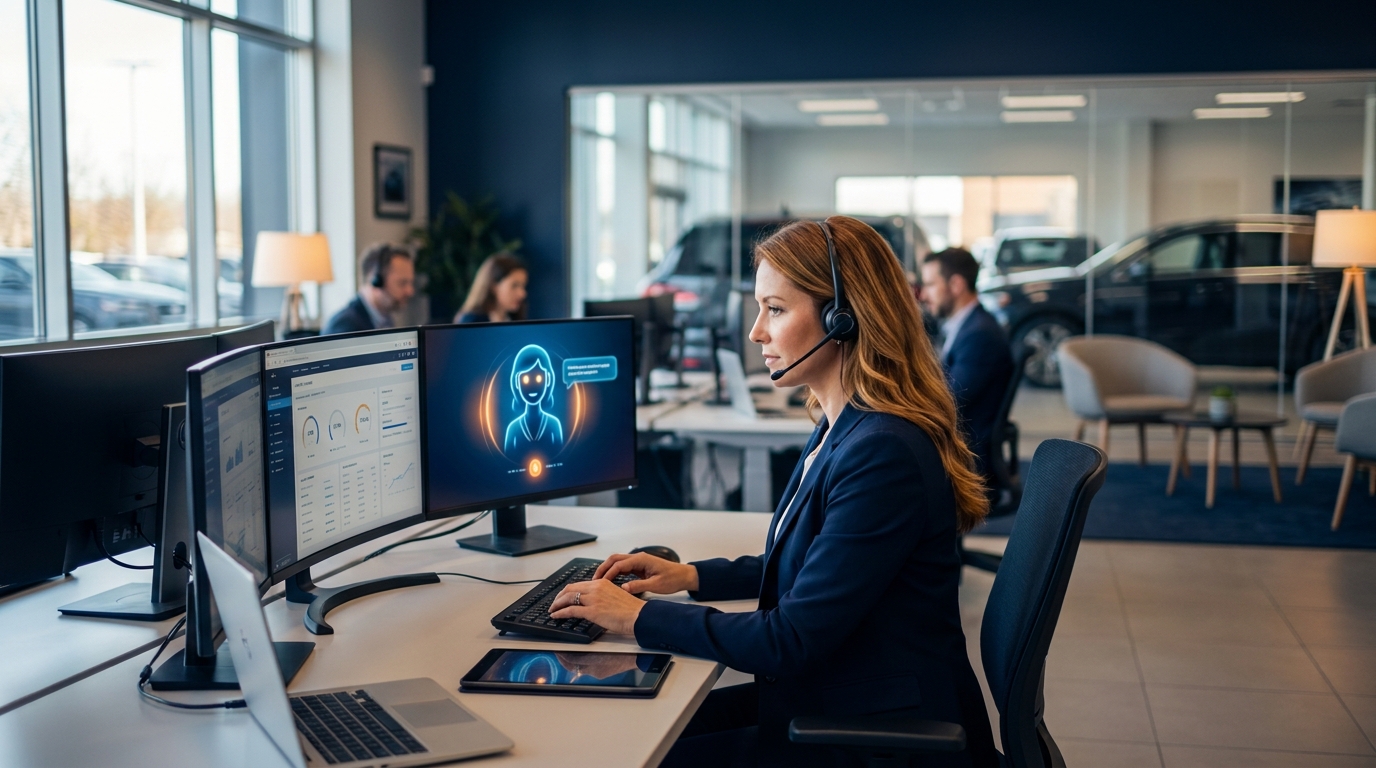
AI BDC for Dealerships: How to Automate Your Business Development Center Without Losing Sales
Your BDC is either your dealership's secret weapon or its most expensive bottleneck. There's no in-between.
Right now, the average dealership spends between $180,000 and $350,000 per year on a traditional BDC — salaries, benefits, training, turnover, management overhead. And even a well-run department still loses leads at 2 a.m., still lets Saturday overflow calls go to voicemail, and still depends on whether your best rep shows up Monday morning.
That's why AI BDC for dealerships isn't a future concept. It's a 2026 reality. Dealers across the country are replacing manual BDC workflows with AI-powered automation that responds to every lead in seconds, follows up without being told, and never calls in sick.
But here's where most dealers get it wrong: they think "AI BDC" means firing everyone and plugging in a chatbot. It doesn't. The smartest implementations use AI to handle the high-volume, repetitive work — instant lead response, after-hours coverage, drip follow-up, appointment confirmation — while freeing your human team to do what they're actually good at: building relationships and closing deals.
This guide breaks down exactly how dealership BDC automation works in practice, what it replaces, what it doesn't, and how to implement it without losing a single sale in the transition.
What a Traditional BDC Actually Costs Your Dealership
Before you can evaluate AI BDC automation, you need to see the real numbers behind your current operation. Most dealer principals know their BDC payroll number. Fewer know the total loaded cost.
The Math Most Dealers Avoid
A single BDC representative costs $35,000–$50,000 in base salary, depending on market. Add benefits, payroll taxes, and you're at $45,000–$65,000. Now factor in management time — your BDC manager spends 20+ hours per week coaching, monitoring, and putting out fires. That's another $30,000–$40,000 in allocated management cost.
A four-person BDC with a manager runs $220,000–$310,000 annually before you account for technology, phone systems, and the CRM seats they need. And that's assuming low turnover — which, in BDC departments averaging 60–80% annual turnover, is a generous assumption.
Every time a rep quits, you lose 2–4 weeks of productivity during hiring and training. Multiply that across the year and your effective cost-per-lead-handled climbs dramatically.
The Hidden Cost: Inconsistency
Even when you're fully staffed, human BDC performance is wildly inconsistent. Your top rep responds in 90 seconds and books 40% of her contacts. Your newest hire takes 22 minutes and books 12%. Both cost you roughly the same.
Industry data from the 2026 lead response time research shows the average dealership takes 47 minutes to respond to an internet lead. By that point, 78% of buyers purchase from the first dealer to respond. Your BDC doesn't just cost money — inconsistent response costs you cars.
How AI BDC Automation Actually Works
An AI BDC isn't a single tool. It's a system of automated workflows that replicate — and often outperform — the core functions of a human BDC department. Here's what that looks like in practice.
Instant Lead Response (Under 60 Seconds, Every Time)
When a lead submits a form on AutoTrader, CarGurus, your website, or any ADF-connected source, an AI Follow-Up Engine engages that lead within seconds. Not minutes. Not "when someone gets to it." Seconds.
The AI reads the lead source, the vehicle of interest, and the customer's message. It crafts a personalized response — referencing the specific vehicle, acknowledging the customer's question, and moving toward an appointment — then delivers it via text, email, or both.
This happens at 10 a.m. on a Tuesday. It also happens at 11:47 p.m. on a Sunday. The response quality doesn't degrade at midnight. It doesn't get distracted during a Saturday rush. It doesn't take a lunch break during peak lead flow.
Owini's Conversational AI handles this entire workflow automatically, engaging leads in natural, human-sounding conversations that move toward appointments without sounding robotic or scripted.
Omnichannel Coverage Without Tab Overload
A traditional BDC rep juggles email, phone, text, Facebook Messenger, Instagram DMs, and sometimes Google Business Messages. That's six platforms, six browser tabs, and six places where leads fall through cracks.
An AI-powered BDC consolidates everything into a single Omnichannel Inbox. Every conversation — regardless of channel — lives in one timeline per customer. The AI can respond across any channel, and when a human rep takes over, they see the complete history in one place.
This alone eliminates the most common BDC failure: the lead who sent a Facebook message, got a reply, then texted a follow-up that nobody saw because it hit a different system.
Automated Drip Campaigns That Never Stop
Here's where human BDCs universally fail: long-term follow-up. Your reps are great at the first call, decent at the second, and terrible at touches 3 through 15. By day 10, most leads are effectively abandoned.
AI BDC automation includes pre-built drip campaigns — sequences of texts and emails triggered by specific events. A lead comes in and doesn't book an appointment? The system enrolls them in a nurture sequence automatically. Day 1, day 3, day 7, day 14, day 30 — each touch is different, each references their vehicle of interest, and each includes a clear call to action.
Owini ships with 21 pre-built campaign templates covering sales follow-up, lead reactivation, sold-customer re-engagement, and service retention. These campaigns auto-enroll contacts from CRM events, run indefinitely with configurable cooldowns, and require zero manual work after setup.
This is the gap that matters most. A human BDC abandons most leads after 2–3 attempts. An AI BDC follows up for months — and catches the buyer who wasn't ready in January but is ready in April.
What AI BDC Replaces — and What It Doesn't
Let's be specific. Not every BDC function is a good fit for automation. The dealers getting the best results know exactly where to draw the line.
AI Replaces These BDC Functions
- First response to internet leads — AI is faster, more consistent, and available 24/7
- After-hours coverage — No more lost leads between 6 p.m. and 9 a.m.
- Follow-up sequences — Drip campaigns replace manual "reminder to call" tasks that reps ignore
- Appointment confirmations — Automated texts confirming and reminding about upcoming appointments
- Lead qualification — AI identifies hot leads vs. tire-kickers before your team spends time
- Price drop re-engagement — When a vehicle's price drops, AI automatically texts every previous prospect who looked at that car
- Inbound call handling — Voice AI answers calls, provides vehicle information, and books appointments
Humans Still Handle These
- Complex negotiations — Trade-in discussions, financing objections, competitive shopping situations
- Escalated complaints — Angry customers need a real person
- Relationship selling — Repeat buyers who expect to deal with "their guy"
- Creative problem-solving — Unique deal structures, special circumstances
The pattern is clear: AI handles volume and speed. Humans handle nuance and emotion. A well-implemented AI BDC doesn't eliminate your team — it eliminates the work your team shouldn't be doing in the first place.
AI BDC for Dealerships: The Implementation Playbook
Knowing AI BDC works is one thing. Knowing how to deploy it without dropping leads during the transition is another. Here's the step-by-step approach that works.
Step 1: Map Your Current Lead Flow
Before you automate anything, document every lead source feeding your BDC. Website forms, third-party leads (AutoTrader, CarGurus, Cars.com), phone calls, walk-ins logged manually, Facebook leads, chat leads. You can't automate what you haven't mapped.
For most dealers in the 5–15 rep range, this reveals 6–10 distinct lead sources — and usually at least 2 that nobody realized were being handled inconsistently.
Step 2: Deploy AI on Your Highest-Volume Channel First
Don't try to automate everything on day one. Start with your largest lead source — for most dealers, that's third-party internet leads via ADF. Connect your ADF feed to the AI Follow-Up Engine and let AI handle first response for those leads immediately.
This single change typically cuts average response time from 30+ minutes to under 60 seconds. The impact on appointment-set rate is measurable within the first week.
Step 3: Layer In After-Hours Automation
Next, extend AI coverage to all channels during your BDC's off-hours. If your BDC operates 8 a.m.–7 p.m., AI takes over from 7:01 p.m. to 7:59 a.m. Every lead, every call, every message gets an instant response regardless of when it arrives.
Industry data shows that 35–50% of internet leads arrive outside business hours. If you're not responding to those leads until the next morning, you're handing half your pipeline to the dealer who is.
Step 4: Activate Drip Campaigns for Unsold Leads
This is where long-term ROI lives. Set up automated campaigns that re-engage leads your BDC has already given up on. The Lead Reactivation campaign targets leads that went cold 30–90 days ago. The Sold Reactivation campaign reaches out to past buyers approaching trade-in timing.
These campaigns run in the background, require no daily management, and consistently produce 3–8 additional appointments per month for the average mid-size dealer. That's found money from leads you'd already written off.
Step 5: Use Speed-to-Lead Tracking to Measure the Shift
You need proof that AI is performing — both for your own confidence and for your team's buy-in. Speed-to-Lead Tracking and the Speed-to-Lead Leaderboard show you exactly how fast every lead gets a first response, broken down by source, time of day, and assigned rep.
Within 30 days, you'll have hard data comparing AI response times to your previous human-only response times. The delta is typically 10–50x faster. That's not a rounding error — it's a fundamental shift in how quickly your dealership engages buyers.
Ready to see what this looks like for your store? Explore Owini's full CRM and AI BDC platform and see how it maps to your current workflow.
Real-World Dealership BDC Automation Scenarios
Theory is useful. Scenarios are better. Here's how AI BDC plays out in the situations your team faces every week.
Scenario: Saturday Lead Surge
It's 11 a.m. on Saturday. Your lot is packed. Your BDC has two reps working (one called in sick). Between 10 a.m. and noon, 14 internet leads come in from your weekend ad spend.
Without AI: Your two reps handle 6 leads within 10 minutes. The other 8 wait 45 minutes to 3 hours. Four of those 8 leads have already received responses from competing dealers. Two have booked appointments elsewhere by the time your rep calls.
With AI BDC: All 14 leads receive personalized text and email responses within 30 seconds. The AI identifies 5 as high-intent (asking about specific vehicles with financing questions) and routes those to available reps with priority flags. The other 9 continue in AI-powered conversation, with 3 booking appointments directly through the automated flow. Your reps focus on the 5 hot leads. Zero leads go cold.
Scenario: Wednesday Night at 9:30 p.m.
A buyer finds your 2022 Tahoe on CarGurus while sitting on the couch after dinner. They submit a lead form at 9:32 p.m. Your BDC closed two and a half hours ago.
Without AI: The lead sits in your CRM queue until 8:15 a.m. Thursday, when your first BDC rep logs in, scans through the overnight leads, and gets to this one at 8:47 a.m. Eleven hours and fifteen minutes after submission. The buyer has already heard back from two other dealers — one responded at 9:33 p.m. with an AI-powered message.
With AI BDC: At 9:32 p.m., the AI texts the buyer: "Hey [Name], thanks for looking at our 2022 Tahoe — great choice. It's got 28K miles and the Premier package. Are you looking to come see it this week?" The buyer responds. The AI answers two questions about the vehicle, confirms availability, and books a Thursday afternoon appointment. By the time your rep logs in Thursday morning, the appointment is already on the board.
Scenario: Price Drop on Aged Inventory
You've got a 2023 Accord that's been sitting for 52 days. Your manager drops the price by $1,500 to move it. In the past 52 days, 11 different leads have inquired about that car.
Without AI: Maybe your BDC manager remembers to pull those leads and call them. More likely, nobody does. The price drop sits on your website and hopes someone notices.
With AI BDC: Price Drop Automation triggers immediately. All 11 previous prospects receive a personalized text: "Great news — the 2023 Accord you were interested in just dropped $1,500. Want to come take another look?" Three respond within the hour. One books an appointment. That's a sale recovered from a lead your team had already moved on from. No other dealer CRM offers this feature.
AI BDC vs. Traditional BDC: The Numbers That Matter
Dealership decisions run on numbers. Here's how AI BDC stacks up against a traditional department across the metrics that actually affect your bottom line.
| Metric | Traditional BDC (4-Person Team) | AI BDC (Owini) |
|---|---|---|
| Annual cost | $220,000–$350,000 | Fraction of the cost |
| Average first-response time | 12–47 minutes | Under 60 seconds |
| After-hours coverage | None (or expensive answering service) | Full 24/7 AI response |
| Follow-up attempts per lead | 2–3 before abandonment | Unlimited (campaign-driven) |
| Time to full productivity (new hire) | 4–8 weeks | Immediate on activation |
| Turnover risk | 60–80% annual | Zero |
| Channels covered simultaneously | 2–3 per rep | All channels, all the time |
| Weekend/holiday performance | Degraded (skeleton crew) | Identical to weekday |
The gap isn't close. On speed, consistency, and cost, AI BDC automation outperforms traditional departments by a wide margin. The only area where humans maintain an edge is high-empathy, high-complexity conversations — which represent roughly 15–20% of total BDC interactions.
Common Objections (and Honest Answers)
If you're a dealer principal or GM considering this shift, you probably have questions. Here are the ones we hear most.
"Won't Customers Know They're Talking to AI?"
The best AI BDC platforms — including Owini — use natural language that mirrors how real salespeople communicate. No robotic responses. No "I am an AI assistant" disclaimers in the opening text. The AI references specific vehicles, asks relevant questions, and adapts based on what the customer says.
Do some customers figure it out? Sometimes. Do they care? The data says no. Customers care about getting a fast, helpful response. Whether that response comes from a human or an AI matters far less than whether it comes in 30 seconds or 30 minutes.
"What If the AI Says Something Wrong?"
Owini AI operates from a dealership-specific knowledge base. You define your inventory, your policies, your hours, your financing options. The AI draws from that knowledge base when answering questions, and it cites its sources internally so your team can verify.
It also includes Smart Pause/Resume — when a human rep picks up a conversation, the AI steps back automatically. No crossed wires. No AI texting a customer while your salesperson is on the phone with them.
"My Best BDC Rep Is Incredible — AI Can't Match Her"
You're probably right. Your top performer might outperform AI on any single interaction. But she handles 40–50 leads per day. AI handles every lead instantly, around the clock, 365 days a year. The question isn't whether AI is better than your best rep — it's whether AI plus your best rep is better than your whole department.
The answer is almost always yes. Let AI handle volume. Let your top performers handle the leads that need a human touch. That's where dealerships see 30–50% improvements in appointment-set rates — not by replacing talent, but by deploying talent where it matters most.
What to Look For in an AI BDC Platform
Not all "AI BDC" solutions are created equal. Some are glorified chatbots. Some only handle one channel. Some bolt onto your existing CRM and create more complexity. Here's what actually matters when evaluating platforms for dealership BDC automation.
Full CRM Integration (or, Better, a Full CRM)
An AI response tool that doesn't connect to your pipeline is a toy. You need AI that lives inside your CRM — or better yet, is the CRM. That way, every AI interaction updates the customer record, moves the deal through the pipeline, and gives your managers full visibility without toggling between platforms.
Some competitors like Hammer AI offer AI lead response without a CRM. Others like Matador bolt AI onto your existing CRM. Owini takes a different approach: the AI is built into the CRM from the ground up — lead intake, pipeline management, follow-up automation, and reporting in one system.
True Omnichannel (Not Just Text and Email)
If your AI BDC only handles SMS and email, you're leaving Facebook Messenger, Instagram DMs, WhatsApp, and Google Business Messages uncovered. Those channels now account for a growing share of dealership lead interactions. Insist on a platform that covers all of them from a single inbox.
Automated Campaigns That Go Beyond Lead Response
First response is table stakes. The real value is in what happens after the first response. Look for platforms with pre-built, auto-enrolling campaign sequences that handle the full buyer journey — initial follow-up, long-term nurture, reactivation, service retention, and post-sale re-engagement.
Inventory-Aware Automation
Your AI should know what's on your lot. When a customer asks "Is the blue Camry still available?" the AI should check live inventory and answer accurately. When that Camry's price drops, the AI should automatically notify every prospect who previously asked about it. When new inventory arrives that matches a buyer's stated preferences, the AI should reach out proactively.
This level of inventory awareness is what separates an AI BDC from a chatbot with a dealership skin.
Marketplace Posting Automation
This is a differentiator most AI BDC providers ignore entirely. Your BDC's job isn't just handling inbound leads — it's generating them. Vehicle Poster automates Facebook Marketplace posting at scale, scraping inventory from 11 sources, generating AI-written descriptions, and publishing in bulk. It's BDC-adjacent work that currently eats hours of someone's week and should be fully automated.
No competitor — not Hammer, not Matador, not DriveCentric — offers this capability. It's a feature unique to Owini's platform.
The Transition: How to Shift from Human BDC to AI BDC Without Disruption
The biggest risk in BDC automation isn't the technology — it's the transition. Here's a proven 90-day playbook for dealers making the shift.
Days 1–30: AI Shadows Your BDC
Run AI in parallel. Every lead that comes in gets an AI response and a human response. Compare speed, quality, and appointment conversion. Use Speed-to-Lead Tracking to measure both. This builds confidence and identifies any knowledge gaps in the AI's understanding of your inventory or processes.
Days 31–60: AI Takes Primary, Humans Monitor
Shift AI to primary first-response for all internet leads and after-hours contacts. Your BDC reps transition from responding to monitoring — reviewing AI conversations, jumping in when complexity warrants it, and handling escalations. Most dealers find that AI handles 70–85% of interactions without human intervention during this phase.
Days 61–90: Optimize and Reallocate
By day 60, you have hard data on AI performance. Use it to make staffing decisions. Most dealers in the 5–15 rep range find they can reduce BDC headcount by 50–75% while maintaining or improving appointment volume. Remaining BDC staff focus exclusively on high-value activities: complex negotiations, VIP customers, and outbound conquest campaigns.
The savings are real: $100,000–$250,000 in annual labor costs redirected to inventory acquisition, marketing spend, or straight to the bottom line.
Want to see how this maps to your dealership's size and lead volume? Check Owini's pricing and compare it against your current BDC spend.
Why 2026 Is the Tipping Point for Dealership BDC Automation
Three converging trends make this the year AI BDC adoption accelerates.
1. Consumer expectations have shifted permanently. Post-pandemic buyers expect instant digital responses. A 2026 Cox Automotive study found that 67% of car buyers prefer starting the purchase process online — and 82% expect a response within 10 minutes. Traditional BDCs can't meet that bar consistently. AI can.
2. Labor costs keep climbing, talent keeps leaving. BDC turnover hasn't improved. Wages have risen 12–18% since 2022 in most markets. The math on a four-person BDC gets worse every year. AI costs stay flat or decrease as technology improves.
3. AI capability has crossed the quality threshold. Two years ago, AI-generated text responses felt stilted. Today's models — trained on automotive conversation data — produce responses that are indistinguishable from experienced BDC reps in blind tests. The technology is ready. The only question is whether your dealership adopts it before or after your competitors do.
The Bottom Line: AI BDC Isn't Optional Anymore
Every lead that waits more than 60 seconds for a response is at risk. Every after-hours inquiry that goes unanswered until morning is a potential sale lost. Every follow-up sequence that dies after two attempts is money left on the table.
AI BDC automation eliminates all three problems — permanently, consistently, and at a fraction of the cost of human-only operations.
You don't have to fire your BDC tomorrow. But you do need to stop pretending that a team of humans manually texting leads is the best you can do in 2026. It's not. And the dealers in your market who figure that out first will take your customers while you're still debating it.
See how Owini's AI BDC works →
Frequently Asked Questions About AI BDC for Dealerships
How much does an AI BDC cost compared to a traditional BDC department?
A traditional four-person BDC typically costs $220,000–$350,000 annually when you include salaries, benefits, management overhead, and turnover costs. AI BDC platforms like Owini cost a fraction of that — often comparable to a single BDC rep's salary — while handling unlimited lead volume around the clock. Most dealers see a positive ROI within 30–60 days of deployment.
Can AI BDC automation handle phone calls, or is it just text and email?
The best AI BDC platforms handle voice calls in addition to text, email, and social messaging. Owini's Voice AI answers inbound calls, provides vehicle information, answers customer questions, and books appointments — all without a human picking up the phone. This is especially valuable for after-hours calls, which represent a significant share of dealership inquiries.
Will my customers be frustrated by talking to an AI instead of a real person?
Research consistently shows that customers prioritize speed and helpfulness over whether they're talking to a human or AI. A lead that gets a personalized, helpful response in 30 seconds is far more satisfied than one that waits 45 minutes for a human to call back. Additionally, Owini's Smart Pause/Resume feature ensures that when a human rep does take over, the transition is seamless with full conversation history preserved.
Does AI BDC work for small dealerships with only a few salespeople?
AI BDC is arguably more valuable for smaller dealerships, where there's no dedicated BDC staff at all. In a 2–5 person operation, salespeople are responsible for their own follow-up — which means leads get lost during busy lot hours, weekends, and evenings. AI fills that gap completely, giving small dealers the same 24/7 response capability that large franchise groups have with full BDC departments.
How does AI BDC handle leads that need to be escalated to a human?
Owini's AI monitors conversation signals — questions about complex financing, trade-in negotiations, complaints, or explicit requests to speak with a person — and automatically escalates those leads to an available rep. The Smart Pause/Resume system ensures AI stops messaging the moment a human takes over, and all AI-generated conversation history is visible to the rep so they have full context before picking up the conversation.