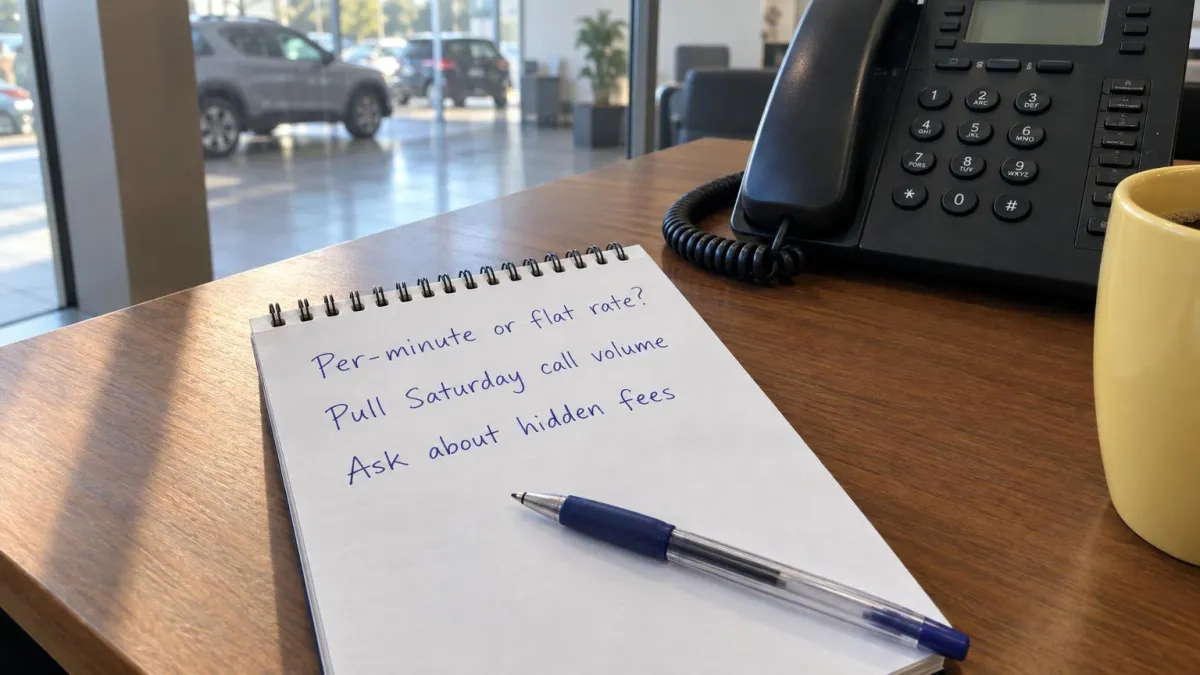
AI Voice Agent Pricing for Dealerships: Per-Minute vs Flat
Why AI Voice Agent Pricing for Dealerships Is Hard to Compare
AI voice agent pricing for dealerships usually comes in two shapes. One is a per-minute rate that bills for every minute the AI spends on the phone. The other is a flat monthly rate that covers usage up to a plan limit or without any limit.
The model you pick decides whether your bill tracks your call volume or stays fixed.
Comparing quotes gets messy fast. One vendor quotes a platform fee plus minutes, another bundles a minute allowance with overages, and a third prices per rooftop.
This guide, updated for 2026, shows how each model behaves on a real store's phone traffic. It covers which model fits which dealership and what to ask before you sign.
Every quote needs a reference point. Say a staffed in-house BDC runs $225K to $270K a year and covers roughly 8 to 5 on weekdays, while the industry average lead response sits around 47 minutes (per Podium's research). Judge any voice AI pricing model against that number, not against the lowest sticker price.
Our AI BDC vs human BDC cost and ROI comparison breaks down that side of the math.
What Is Per-Minute AI Phone Agent Pricing?
Per-minute AI phone agent pricing is a usage model where the dealership pays a rate for every minute the voice AI spends on a call, usually on top of a base platform fee. Your monthly cost rises and falls with call volume, call length and, with some vendors, whether the call was inbound or outbound.
The appeal is clear: a slow month costs less. For a store with modest phone traffic and a team that still answers most calls during business hours, metered pricing keeps the voice AI line item small while the AI covers overflow and after-hours calls.
The drawback shows up in busy months. Saturday rushes, a holiday sale, a new OEM incentive or a strong month on CarGurus all push minutes up while your sales team is stretched. The bill grows when the AI does the most work, which makes forecasting harder for a GM.
What Is a Flat-Rate AI Voice Agent?
A flat rate AI voice agent bills at a fixed monthly price no matter how many minutes the AI spends on the phone. Some flat plans carry a fair-use cap, while fully unmetered plans charge nothing per minute.
Either way, the dealer knows the cost on day one of the month.
Flat pricing changes how a store uses the AI. When nobody watches a minute counter, managers let the AI take every call, call back every lead, run full qualification conversations and talk to shoppers in their preferred language. Cost per conversation drops as volume rises.
The tradeoff is a higher fixed commitment in slow months. A store that takes few calls and gets a handful of internet leads a week may pay for capacity it does not use.
Per-Minute vs Flat-Rate Dealership Voice AI Cost: Side by Side
Per-minute pricing favors low, steady inbound call volume. Flat pricing favors high volume, outbound calling and stores that want a fixed budget line. The table compares how each model behaves on the factors a dealership feels on the invoice.
| Factor | Per-minute pricing | Flat-rate pricing |
|---|---|---|
| Monthly predictability | Varies with call volume and length | Fixed |
| Busy months (weekends, sales events) | Bill rises with traffic | No change |
| Outbound calls to new leads | Every call adds billable minutes | Included |
| Long qualification calls | Longer calls cost more | No penalty |
| Multilingual conversations | Metered like any other call | Included |
| Slow months | Lower bill | Same bill |
| Best fit | Inbound overflow and after-hours coverage | AI BDC augmenting or replacing a human team |
How Do You Estimate Your Store's Voice AI Minutes?
Add the inbound calls you want the AI to answer, the outbound calls to new internet leads and the follow-up attempts, then multiply by average talk time. Pull these numbers from your phone system and CRM before requesting quotes, so every vendor prices the same workload.
- Count inbound calls. Pull 90 days of call logs, including after-hours and missed calls. Missed calls are the first ones the AI would pick up.
- Count internet leads by source. Total your monthly leads from CarGurus, Autotrader, Cars.com, Facebook lead ads, ADF email and OEM portals.
- Decide on outbound coverage. If the AI calls every new lead, each lead creates at least one outbound call plus any retries.
- Measure average talk time. Calls covering trade-ins and appointments run longer than an hours-and-directions call.
- Use your busiest month. Calls times minutes gives a baseline. Price against last year's heaviest month, not the average.
- Get totals, not rates. Ask every vendor for the full monthly cost at both your baseline and your busy month.
Here is a hypothetical to check against your own store. 1,200 inbound calls a month at 3 minutes each is 3,600 minutes. Add 400 internet leads with two outbound attempts at 2 minutes each and you add 1,600 more.
That is 5,200 billable minutes before a single sales event. Multiply by any vendor's per-minute rate and compare it to their flat price.
When Does Per-Minute Voice AI Pricing Make Sense?
Per-minute pricing makes sense when the voice AI handles inbound calls only, your team still answers most calls during the day, and volume stays steady month to month. In that setup the AI acts as an overflow and after-hours safety net, and metered billing ties cost to the calls it takes.
This fits many smaller independent stores and dealerships testing voice AI before changing their BDC structure. The AI answers the 9 p.m. call about a trade-in, books the appointment and logs the conversation, and you pay for those minutes only.
Watch for one pattern. If your team starts routing more calls to the AI because it answers well, the meter climbs. That is usually the sign to move to a flat plan.
When Does Flat Pricing Win? Outbound AI BDC Changes the Math
Flat pricing wins when the voice AI makes outbound calls. An AI BDC that calls every internet lead generates minutes on every lead, every follow-up and every no-answer retry. Metering that activity puts a price on each lead you call, which pushes managers to call fewer of them.
Speed is where the money is. Owini's outbound Voice AI calls a new internet lead in about 8 seconds, 24/7/365, roughly 350x faster than the 47-minute industry average. That speed only pays off if the AI calls every lead, including the 11 p.m. Autotrader submission and the Sunday Facebook lead ad.
Language coverage adds minutes too. An AI BDC working in 50+ languages holds full conversations with shoppers who would otherwise wait for a bilingual salesperson or hang up.
On a flat plan, those calls cost nothing extra. That is why flat pricing is usually the better fit for stores using voice AI to augment or replace a human BDC.
For the mechanics, read how outbound Voice AI calls every internet lead in 8 seconds. Or skip the reading and talk to the AI yourself in 30 seconds, with no form and no sales call.
Tap. Talk. Done.
Hidden Costs in AI Voice Agent Pricing for Dealerships
The headline rate rarely shows the full dealership voice AI cost. Setup fees, integration charges, per-seat licenses and overage rules can change the real monthly number. Ask each vendor these questions in writing before you compare quotes.
- Do you bill inbound and outbound minutes at the same rate?
- Do transfers to a salesperson, hold time and voicemail count as billable minutes?
- Is there a minimum monthly commitment, or a minute allowance with overage charges?
- Does the AI write calls, transcripts and appointments into your CRM, or does that need a paid integration?
- Are additional languages included or priced separately?
- Is there a setup or onboarding fee, and how long until the AI is live?
- Does the AI read live inventory, or answer from a script?
The CRM question matters most. A voice agent bolted onto a separate CRM can answer the phone, but your team still has to find the call, read the notes and update the lead.
That labor is a cost, even if it never appears on the invoice. The AI voice agents for car dealerships buyer's guide covers the feature side of vendor selection.
How Owini Prices Voice AI: Advanced vs Unlimited
Owini offers both pricing models, matched to how a store uses voice AI. The Advanced tier includes Inbound Voice AI metered per minute. The Unlimited tier (Most Popular) adds the Full AI BDC with outbound auto-calling and Unlimited AI Compute, so there are no per-minute charges.
Advanced fits stores that want inbound call coverage alongside the full CRM, Inventory-Aware AI, Dynamic FB Ads, the 9-stage pipeline and the 7-channel Omnichannel Inbox. Inbound Voice AI answers calls with your live inventory and books appointments, and you pay for the minutes used.
Unlimited fits stores ready to augment or replace a human BDC. The Full AI BDC auto-calls every lead from CarGurus, Autotrader, Cars.com, Facebook lead ads, ADF email and OEM portals in about 8 seconds, in 50+ languages, with no minute counter running. It also includes Vehicle Poster posting, a dedicated account manager and white-glove onboarding.
The CRM also includes Ask Owini, the AI employee that works for your team. It reads and summarizes your calls, so nobody has to type a note. It comes included in the plan, not sold as a per-seat upsell.
Owini quotes pricing per store, scaled to inventory size. See pricing for your store and compare it to the $225K to $270K a year staffed BDC figure above.
Don't take our word for how the AI sounds. Try the voice AI yourself right now, then book a demo to map your call volume to the right tier. No long-term contracts required to see it work.
Frequently Asked Questions
How much does an AI voice agent cost for a car dealership?
Start with the alternative. A staffed in-house BDC costs $225K to $270K a year and covers business hours only. AI voice agent pricing runs a fraction of that, billed either per minute or as a flat monthly rate. Owini quotes its Advanced and Unlimited tiers per store based on inventory size. See owini.ai/pricing for a live quote.
Is per-minute or flat-rate voice AI better for dealerships?
Per-minute pricing fits stores that use voice AI for inbound overflow and after-hours calls with steady volume. Flat pricing fits stores that use outbound AI BDC to call every internet lead, because metered billing charges for every call, follow-up and retry. If you want the AI calling every lead, flat pricing removes the reason to hold back.
Does Owini charge per minute for voice AI?
On the Advanced tier, Inbound Voice AI is metered per minute. On the Unlimited tier, Unlimited AI Compute means there are no per-minute charges, and the Full AI BDC auto-calls every internet lead in about 8 seconds, 24/7/365.
What should an AI receptionist for dealers include in the price?
At minimum, the price should cover inventory-aware answers, appointment booking, call transcripts written into your CRM, and after-hours coverage. Ask whether transfers, voicemail and extra languages count against your minutes. Owini's voice AI works inside the CRM, and the AI BDC speaks 50+ languages.
Can a flat-rate AI voice agent call internet leads automatically?
Yes, if the plan includes outbound calling. Owini's Unlimited tier auto-calls leads from CarGurus, Autotrader, Cars.com, Facebook lead ads, ADF email and OEM portals within about 8 seconds. While a lead waits 47 minutes for a callback (the industry average), they are filling out forms at other stores.